🏗️ Architecture
This page gives a high-level view of MMORE and explains how the main components fit together.
It is meant to help readers understand the system before diving into implementation details.
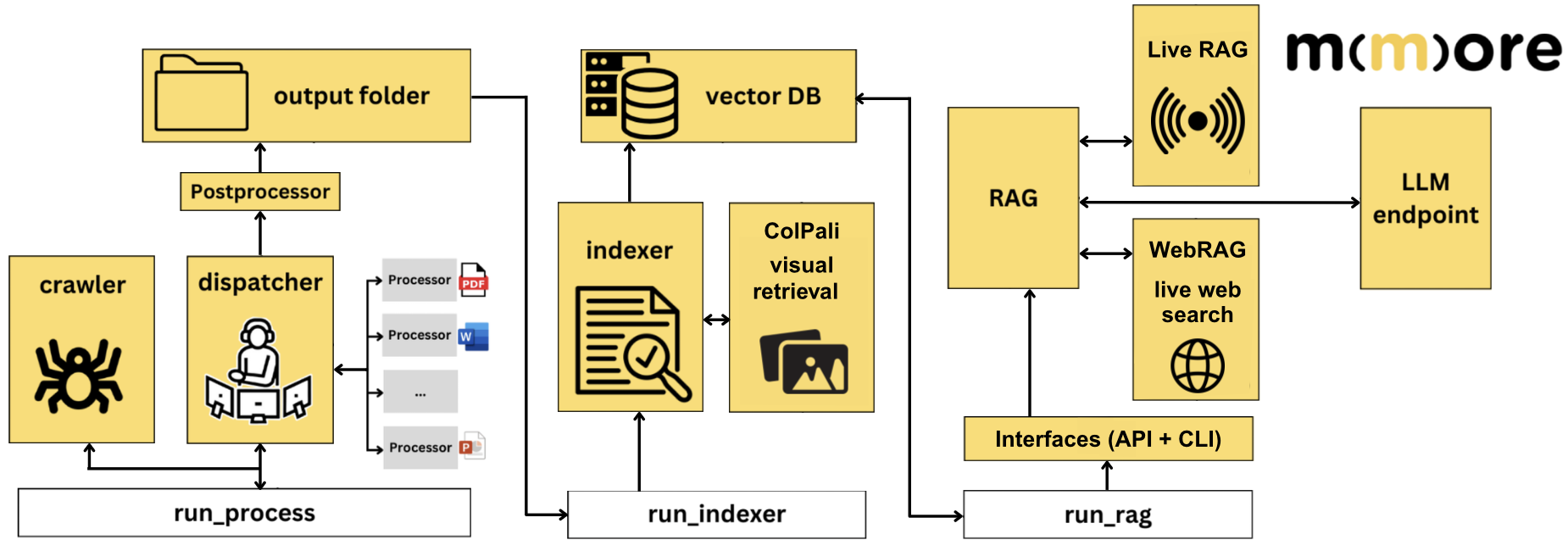
High-level overview of the MMORE pipeline, from processing and indexing to retrieval and RAG workflows.
Overview
MMORE is designed as a multimodal ingestion and retrieval framework for heterogeneous document collections.
MMORE is organized around three main executable stages:
run_process, which handles ingestion, crawling, dispatching, and document processingrun_indexer, which builds the searchable index and can integrate multimodal retrieval components such as ColPalirun_rag, which serves retrieval and RAG workflows through interfaces such as the API and CLI
These stages interact with intermediate outputs, the vector database, and optional external components such as hosted LLM endpoints, WebRAG, or Live RAG.
At a high level, the system follows a pipeline like this:
Data sources
    ↓
Ingestion and processing
    ↓
Structured representations
    ↓
Indexing
    ↓
Retrieval / reranking
    ↓
Optional RAG generation
    ↓
Evaluation / profiling / production deployment
Main components
1. Ingestion and processing
This stage takes raw inputs and transforms them into normalized, usable representations.
Depending on the document type and workflow, this may involve:
loading files from one or more sources
extracting text, metadata, or layout information
chunking long documents
preparing multimodal content representations
organizing outputs for downstream indexing
This part of the pipeline is documented in Processing pipeline.
2. Indexing
The indexing stage converts processed content into searchable artifacts.
Typical responsibilities include:
selecting what unit to index, such as full documents or chunks
generating representations used for retrieval
storing indexes in a format suitable for fast search
managing index lifecycle and updates
This stage is documented in Indexing.
3. Retrieval
Retrieval is responsible for finding relevant content for a query.
Depending on the setup, this can include:
lexical or semantic retrieval
multimodal retrieval
hybrid retrieval strategies
reranking or score refinement
The retrieved outputs can be returned directly to the user or passed into a downstream generation system.
4. RAG workflows
When MMORE is used in a retrieval-augmented generation setting, retrieval outputs are passed into a generative layer.
The quality of the final result then depends on:
document processing quality
chunking choices
index quality
retrieval relevance
prompt and generation design
See RAG for more details.
5. Multimodal support
A key aspect of MMORE is support for heterogeneous and multimodal collections.
That means the framework may work with:
plain text documents
structured metadata
images or layout-aware representations
multimodal retrieval models such as ColPali-related components
See ColPali for the multimodal retrieval side.
6. Distributed execution
6. Distributed processing
For larger workloads, MMORE supports distributed execution in the processing stage.
This is useful when:
the input collection is large
document processing is computationally expensive
ingestion needs to be parallelized across multiple jobs or nodes
7. Evaluation and profiling
MMORE also includes tooling to inspect and improve system quality and performance.
Two complementary concerns matter here:
evaluation, which measures retrieval or pipeline quality
profiling, which measures runtime behavior and performance bottlenecks
See Evaluation and Profiler.
Design principles
MMORE is organized around a few simple principles:
clear separation between stages of the pipeline
modularity between processing, indexing, retrieval, and evaluation
support for heterogeneous and multimodal data
scalability from local experiments to larger deployments
readability for both users and contributors